
Beyond Robotics Complexity: Our Perspective on Robotics Investment Opportunities
The robotics investment landscape is entering what many call a golden age. Funding is surging, humanoids are capturing headlines, and the promise of capable robots performing real jobs feels tantalizingly close. Yet we predict that a surprising number of robotics companies will fail in the next 24 months, not because the technology is impossible, but because we see a lack of understanding for the remaining complexity in building functioning robotic solutions and robotics companies. Too many are rushing products to market before they're ready.
At Ellipsis Venture, we've learned that in deep tech and robotics, 99% is often not enough. Much of the real value, and the real difficulty, lives in that final push from 99% to 99.99% reliability. This isn't pessimism; it's pattern recognition from two decades in the trenches of building and scaling deep technology. So, by balancing our optimism with experience, we're taking a contrarian approach to robotics investment.
Our Position
We see enormous opportunity in robotics, but we're hunting in different territory than the megadeals chasing humanoid and full autonomy hype. We focus on pragmatic robots, systems that capture value in ways their companies have a realistic chance of completing.
The Story of Robotics Investment and Hidden Complexity
Let's start with the encouraging news. Global venture funding in robotics startups in 2025 is set to significantly exceed the five-year median. Humanoids are dominating the conversation, and interestingly, Switzerland, particularly the greater Zurich area, is punching above its weight with the largest Swiss funding rounds in robotics happening right here. Every major region (i.e. China, EU, US) is experiencing funding growth.
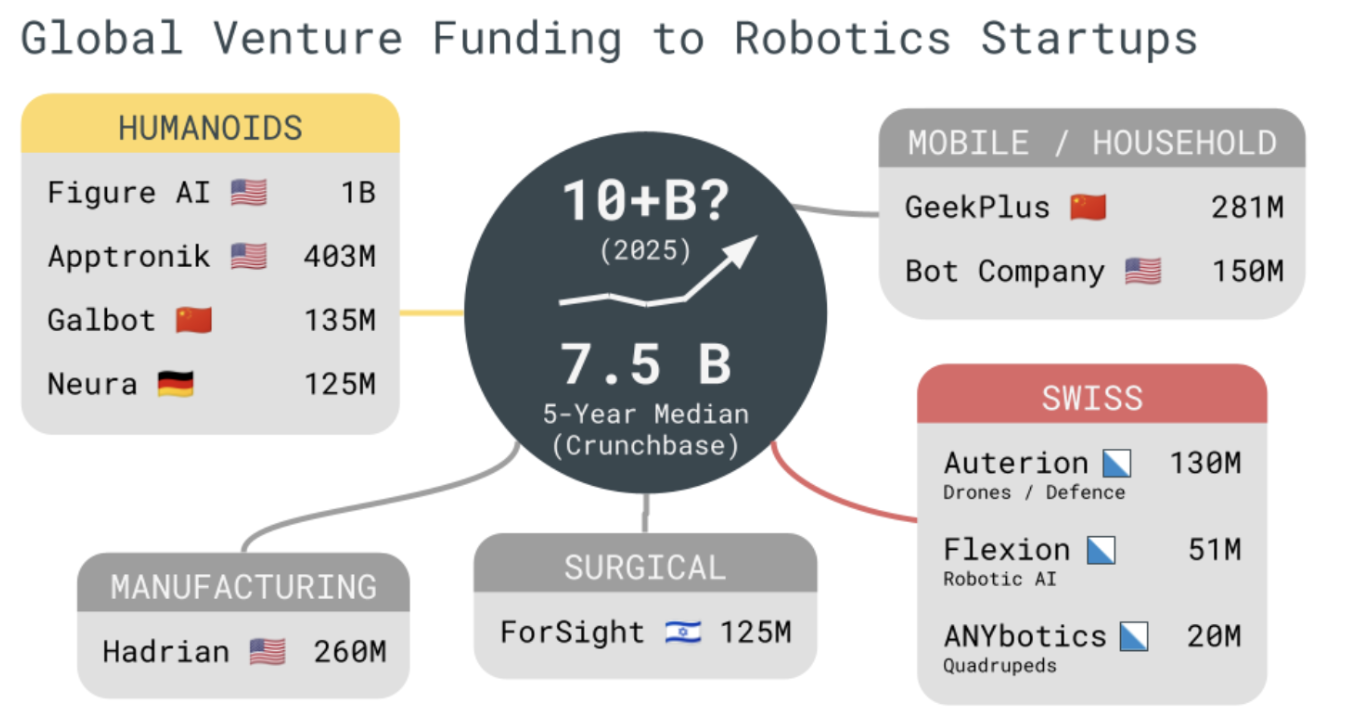
Global Venture Funding to Robotics Startups
The fundamentals driving this investment wave are real. AI breakthroughs are the obvious catalyst, but they're not the only one. Motors are smaller and more powerful than ever. Sensors have dramatically improved. GPU capabilities continue their exponential march forward. Workforce availability is declining in key sectors, and the cost per robotic task is approaching critical inflection points. Consumers are increasingly comfortable with simpler robotic systems in their daily lives. This perfect swirl of technological and economic factors makes it feel like all the barriers of creating capable robotics will finally be overcome. However, we see a remaining complexity in robotics.
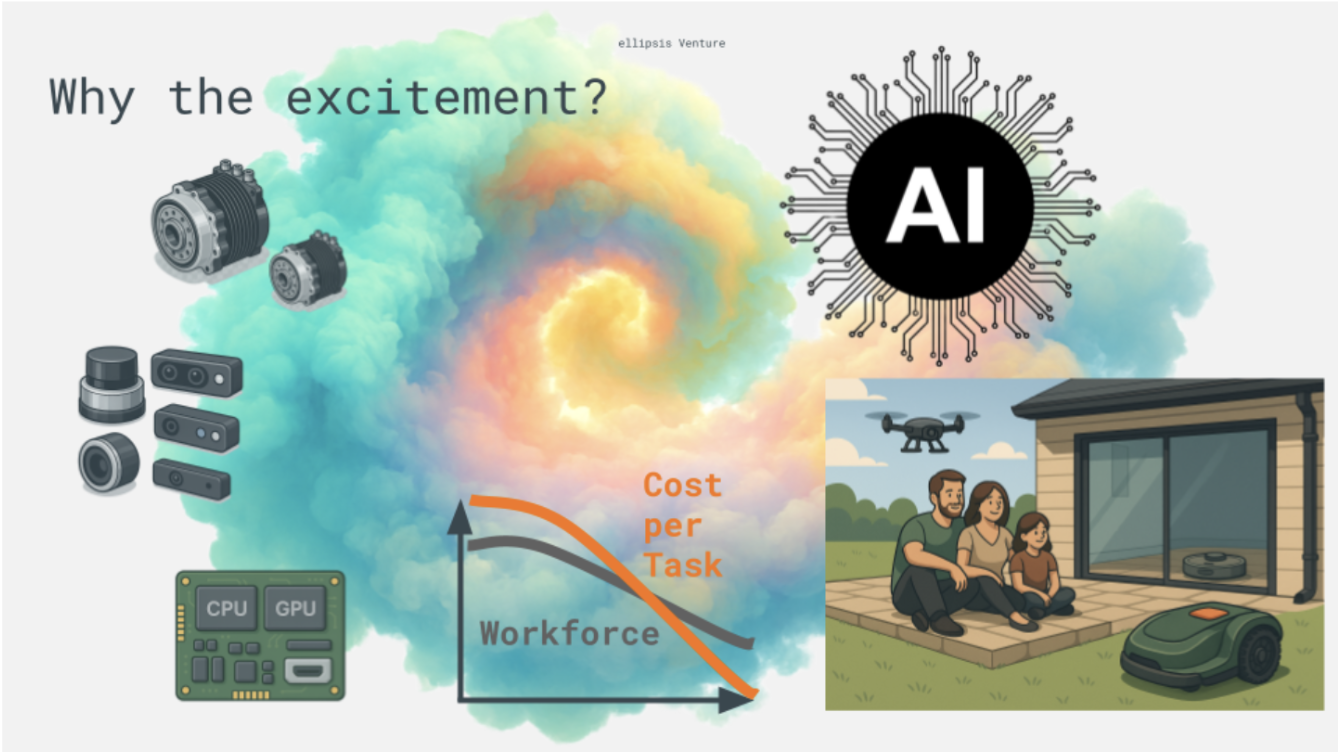
Why the excitement? - Factors driving robotics investment
Movement vs. Job Performance
Performing sophisticated movements is largely solved. Watch any video of modern humanoids or (wheeled) quadrupeds and you'll see incredible feats. Robots falling, recovering faster than humans, executing complex maneuvers. This appears impressive and the movements are mesmerizing. But movement is not the same as performing jobs at the level we take for granted in human workers. Robotics must now transition from making robots going anywhere to robots performing jobs well everywhere.
The Autonomous Driving Lesson
Consider autonomous driving, which should have been the easy case. The hardware has been solved for decades, the environment is relatively structured, and the task is comparatively simple. Yet it took 16 years to offer reliable rides to and from the San Francisco airport, and industry leaders tell us it will be 2030 before they can service the entire San Francisco area. Services are expanding to new cities, but initially within limited regions. Think about that. The "easy" example of applying intelligence to already-mature hardware, in a relatively controlled environment, with massive capital investment, still requires deployment in small, carefully managed areas.
Now extrapolate to humanoids operating in unstructured environments, performing intricate workflows, handling interconnected tasks. The complexity doesn't scale linearly. It explodes exponentially. Humanoids represent the pinnacle of robotics complexity, and they're nowhere near maturity. The lessons from autonomous cars don't transfer as easily as you'd think. Cars can carry massive computing power, extensive memory, and high-end sensors. These are luxuries that smaller, mobile robots simply don't have.
What we see as incomplete and requiring breakthroughs in robotics:
- Understanding of surroundings
- High-level reasoning & planning
- Complex (mobile) Manipulation
- Dexterous hands & tactile sensing
- Truly reliable learning transfer
- Power and energy i.e. long-term autonomous operation
- Multi floor operation with certification e.g. ATEX
The main two capabilities that remain incomplete are i) robots truly understanding their surroundings at a meaningful level and ii) achieving high-level reasoning and planning to comprehend the jobs they're meant to perform. Without these, you have expensive hardware that can move impressively but can't reliably execute value-creating work. See our full list above, however, some are flexible. For example, full hand dexterity is essential for some work, but an overpriced optimization for a large portion of real-world jobs that simply don't require it. Companies that realize this and solve use cases at high levels of performance with the right end effectors for the job will greatly profit.
The Complexity Challenge
This creates a fascinating and risky investment landscape. Most investors focus directly on return on investment calculations, assuming the technology will work and silently presuming the product can be completed. This assumption is valid in software development, where iteration is cheap and deployment is fast. But robotics companies are inherently complex organisms, interweaving software, hardware, multiple requirement loops flowing to and from the market, manufacturing considerations, and regulatory compliance. The ability to make a product truly ready is deeply linked with managing this complexity. If that complexity isn't mastered, companies risk accumulating crushing overhead burdens while never finishing the product, never unlocking the value everyone expects.
Case Study: The 99% to 99.9% Gap
A concrete example from my previous work at ANYbotics. By 2021, we had reinforcement learning systems that could navigate concrete stairs and unstructured terrains well. That seductive 99% success rate was quickly on our horizon. But it took three full years of better data, models, sensor filters, and much more to achieve the 99.9%+ reliability needed for the metal, open-grated, "transparent" stairs our customers actually needed in industrial environments. While most hope for AI generalization to bridge this reliability gap, current data suggests that every use case, workflow, and real life situation will require similar diligence. This hidden complexity, the required investments into true product readiness, and patience before a robotic product can truly succeed in the market are elements that will make and break many robotics companies.
The Premature Commercialization Risk
1X's recent launch of NEO, nearly void of meaningful autonomous capabilities despite the perfect autonomy shown in the launch video, will be interesting to observe. Their robotic system is clearly not market ready, yet they're going to market, hoping to tap into deployment data as a way of closing the full autonomy gap. Equating robotics deployment with web app or smartphone releases, where you can ship buggy products and iterate quickly based on user feedback, will likely prove to be a fundamental mistake. However, we're open to positive surprises. In robotics, premature commercialization doesn't just disappoint customers; it can destroy companies. Our prediction: The gap won't be only filled with data and models. Some people will share, however, many will resist this historical privacy swap. As the trained eye can see, NEO still has physical design issues that will limit or inhibit real-world operation of their current robotic system. Dealing with these will distract 1X more than they realize and slow their humanoid progress compared to companies with different approaches to product maturity and real work robotics adoption.
A Warning Sign
There are currently more than 50 companies producing humanoids, and all of them need multiple major breakthroughs. Our prediction: A surprising number will fail in the next 24 months as products and business models fail to fulfill their promises and funding evaporates. Days ago, on November 5th, 2025, K-Scale Labs, a company with 1 million pre-orders, shut down because they couldn't secure continued investment. While this isn't yet a pattern, could this be the first domino to fall?
Investment Perspective
So how do we invest in this environment? At Ellipsis, we're contrarian but not cynical. We see enormous opportunity in robotics, but we're hunting in different territory than the megadeals chasing humanoid and full autonomy hype.
Our simplified recipe focuses on pragmatic robots, systems that capture value in ways their companies have a realistic chance of completing. We look for teams obsessed with operating in the real world. We avoid companies that require multiple major breakthroughs to succeed; one breakthrough is exciting, but multiple dependencies multiply risk exponentially.
We seek robotics solutions that can tap into specific verticals where the capability match is tight and the value proposition is clear. We favor business models combining hardware and software revenue streams, creating multiple pathways to sustainable economics. And critically, we actively work with our portfolio companies to embrace a "learn over earn" phase, deploying early but not scaling commercialization until the systems are boringly reliable, even in new environments.
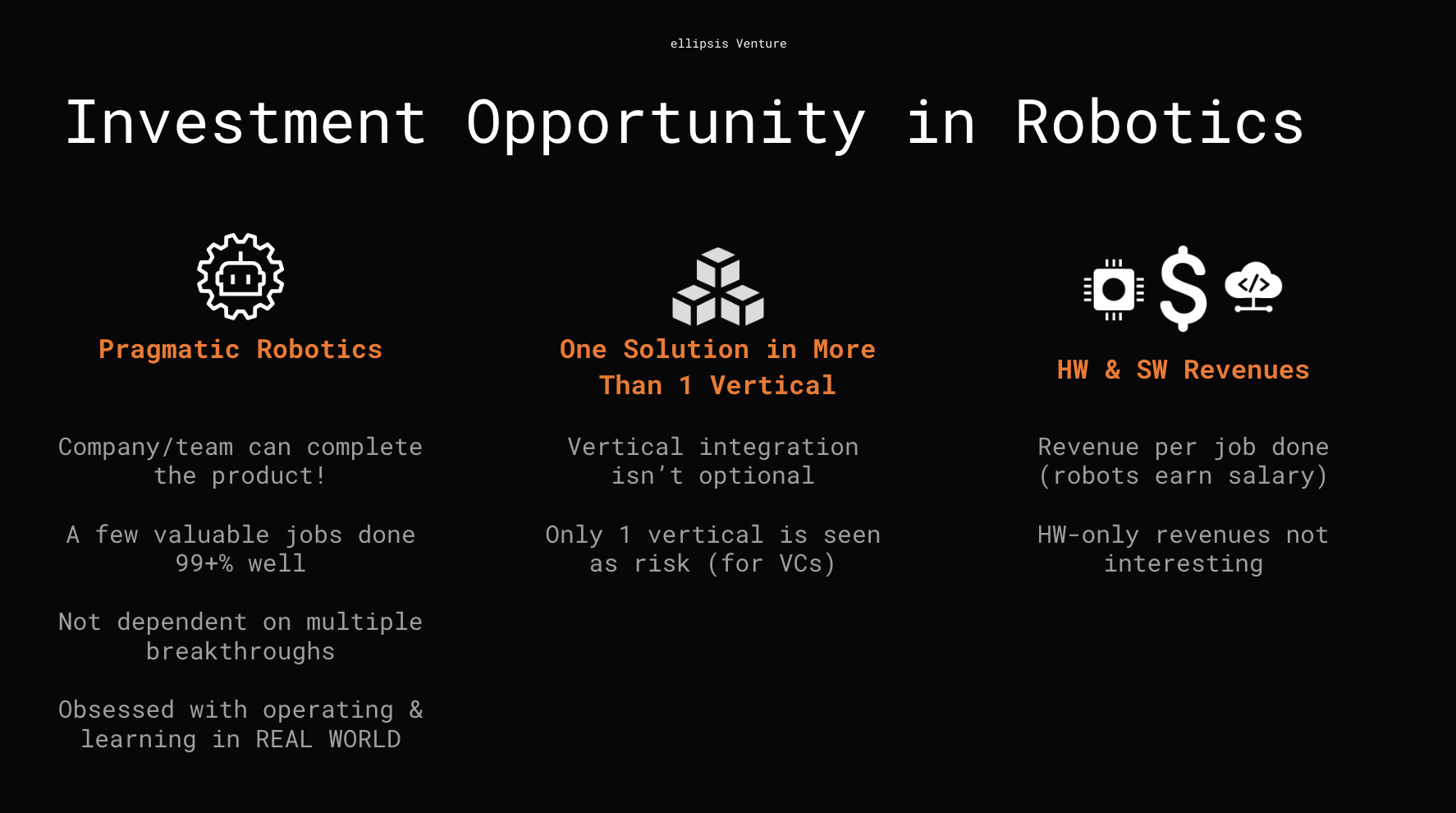
Investment Opportunity in Robotics - ellipsis Venture
This approach recognizes a fundamental truth that many investors are ignoring: in robotics, the path from exciting prototype to reliable product is longer, harder, and more capital-intensive than almost anyone predicts, even the robotic companies themselves underestimate what it will truly take. The companies that will win aren't necessarily the ones with the most impressive demos or the largest funding rounds. They're the ones that understand complexity, manage it ruthlessly, and resist the siren song of premature scaling. For those who misjudge, rapidly learning to re-focus and large funding will be key to turning around their products and companies.
A Contrarian Prediction
There's another prediction I want to make that runs counter to conventional wisdom in the West: the narrative that "East is best at manufacturing, West is best at software" is not just wrong, it's dangerously short-sighted. China is amazing at both, and they're coming soon and hard with much more intelligent software and embodied AI. They will bring a new wave of capable robots able to perform real jobs, and Western companies and investors who dismiss Chinese robotics capabilities will be caught flat-footed.
Conclusion
Yes, we are entering a golden age of robotics investment, but we believe it will be a selective golden age. Capital will shift from mega-rounds chasing humanoid dreams to deployment financing for pragmatic systems that actually work, including those few humanoid solutions showing real promise. The gap between impressive demos and boringly reliable products is where fortunes will be made and lost.
At Ellipsis Venture, we're betting on the companies that understand this gap, respect it, and have the discipline to bridge it properly. We're looking for founders who know that 99% isn't good enough, who are willing to spend years closing that final reliability gap, and who can manage the inherent complexity of robotics companies without letting it become an organizational burden.
The robots are coming, that much is certain. But which robots, from which companies, performing which jobs profitably? Those answers will separate the visionaries from the casualties. If you're navigating the complexities of robotics investment and want to discuss these perspectives further, we're here for that conversation.
The future of work is being built in labs and factories right now. Let's make sure we're backing the builders who can truly deliver.
Full Presentation: Global Robotics & Investment Trends
Ready to Build the Future?
Are you building a robotics company with pragmatic solutions and realistic paths to completion? We want to hear from you.
Send Us Your Deck